
To register for an upcoming offering, "click Sign-up"
Registration is available 30 days prior to the offering.
Certificate of Completion
To receive a certificate of completion, the participant must enter a confirmation code and complete an evaluation survey. Enter confirmation code in the field marked “Enter code” and click the arrow button. Upon completion of the evaluation, a certificate will be available for printing or downloading. The certificate code will expire one week following the webinar.

Upcoming Webinars
*** Changes in 2026 ***
![[ICON Academy logo]](/Content/Images/icon-academy-logo-320.png)
ICON Academy webinars were offered at no cost through a partnership with Dräger Medical. This concluded on April 30, 2026.
Beginning May 1, 2026, ICON Academy’s AARC-accredited webinars are available to ALL respiratory care professionals for a registration fee of $10 US per webinar per person. For the fall 2026 Respiratory Care Week, we are offering a package of 8 ticets for $70 dollars.
The registration fee is nonrefundable and nontransferable. You MUST attend the live webinar to receive your CEU.
You may still watch in a group, and only one person would need to log into the webinar, but each person desiring a CEU credit must sign up and pay the registration fee before the start of the webinar.
To receive the CEU, the process is similar to currently claiming a CEU:
- A "CEU Code" (confirmation code) will be displayed at the end of the webinar
- Each person who has registered must go to the ICON website and log in
- Enter the confirmation code on the Academy Registration page
- Fill out the questionnaire
- Download the Certificate (optional; we send AARC notifications at the end of each month of completed CEUs.)
Fall Respiratory Care Week 2026
The Asynchrony Detective: Recognizing and Correcting Patient-Ventilator Asynchrony Before It Leads to Harm
- Date: Oct 26, 2026 12:00 PM Eastern
- Speaker: Danielle Hardy, BSRT, RRT-ACCS, RCP
Contact Hours: 1
AARC, ANCC, CaBon
APRV Myths & Misconceptions (Adult Acute Care)
- Date: Oct 26, 2026 3:00 PM Eastern
- Speaker: Maria Madden MS, RRT-ACCS
The purpose of this lecture is to review APRV-TCAV settings and to clear the myths of APRV.
Objectives
- Review APRV-TCAV settings
- Review the myths surrounding the use of APRV-TCAV
Contact Hours: 1
AARC, ANCC, CaBon
Assessing the Respiratory Patient Across Modalities HFNC, NIV, and Invasive Ventilation (Adult Acute Care)
- Date: Oct 27, 2026 8:00 AM Eastern
- Speaker: Maria Madden MS, RRT-ACCS
Contact Hours: 1
AARC, ANCC, CaBon
Volume Guarantee: protecting the preterm lung through gentle ventilation
- Date: Oct 27, 2026 2:00 PM Eastern
- Speaker: Kim Smith, RRT-NPS
Contact Hours: 1
AARC, ANCC, CaBon
Change Management: Why is Change Hard?
- Date: Oct 28, 2026 12:00 PM Eastern
- Speaker: Martin Koehnlein MHA, RRT-NPS, ACCS, RPFT, CCT
Contact Hours: 1
AARC, ANCC, CaBon
Please Re-evaluate your Ventilation Choice: Dangers of PRVC and How to Avoid VILI
- Date: Oct 29, 2026 1:00 PM Eastern
- Speaker: Joseph Shiber, MD, FNCS, FCCM
Title volume guarantee: protecting the preterm lung through gentle ventilation.
Objectives
- Describe the principles of volume guarantee ventiliation
- Identify strategies to minimize ventilator induced lung injury volume guarantee
- Apply volume guarantee settings to optimize ventilation and maintain appropriate tidal volumes
Contact Hours: 1
AARC, ANCC, CaBon
Beyond the Norm: How Neurodivergent Clinicians Strengthen Healthcare
- Date: Oct 29, 2026 3:00 PM Eastern
- Speaker: Karen Wockenfuss, BS RRT-ACCS, RRT-NPS
Objectives
- Define neurodiversity and describe its relevance to the healthcare workforce
- Identify strengths and barriers associated with neurodivergence in clinical practice
- Discuss reasonable adaptations that support neurodivergent healthcare workers
Contact Hours: 1
AARC, ANCC, CaBon
Beyond ‘Time Served’: Building Efficient, Competency-Based Respiratory Therapy Orientation.
- Date: Oct 30, 2026 12:00 PM Eastern
- Speaker: James P. Keith BS, RRT, RRT-NPS, RRT-ACCS, AE-C, C-NPT
Contact Hours: 1
AARC, ANCC, CaBon
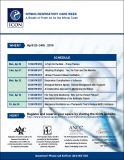
*ICON reserves the right to change speakers or cancel presentations as needed.
System Requirements
As of March 2021, we are using the Zoom service to host our webinars. Please test your computer or mobile device for connectivity.

-
For Microsoft® Windows 7® SP1, Windows 8.x®, Windows 10®
- Internet Explorer 11
- Edge 12 or higher
- Firefox 27 or higher
- Chrome 30 or higher
-
For Mac OS X v10.9 or higher
- Chrome 30 or higher
- Safari 7 or higher
- Firefox 27 or higher
-
For *NIX based OSs (recommend distributions: RHEL 6.4 or higher, OpenSUSE 13.2 or higher, Ubuntu 10 or later, Solaris 10)
- Chrome 30 or higher
- Firefox 27 or higher

-
For iOS mobile devices (iPhones--iOS 8.0 or later, iPads--iPadOS 13 or later, etc.)
- Safari 5 or higher
- Chrome
-
For Android mobile devices (phones, tablets, etc.)
- Chrome